



Within the Platform of Goodness project, the editorial staff of Platfor.ma online magazine pay visits to worthy projects, personally help their causes, and write pieces about their experience to raise awareness of important initiatives and show people that helping others is easy. This time, making a donation, we visited the Kyiv Volunteer Charity Foundation, which has transformed from a restaurant alliance into a full-fledged charity foundation working in different areas, implementing various projects, and having grandiose plans for the future.
🇺🇦 Text in Ukrainian is available here🇺🇦
“We’ve for a long time been thinking about how to describe Volunteer Kyiv in one phrase,” says Daryna, the Foundation’s communicator. “It’s hard, for we do everything. If bread is needed in Izium, Bakehouse bakes the bread and we deliver it there. If someone needs equipment, we accept the request and work on it, if thermal underwear — we get thermal underwear, and if a drone — we get a drone. So we came to the point that Kyiv Volunteer is a foundation that promptly responds to any society requests, and looks like little by little, we manage to fulfill them all.”
Back in the spring and early summer of 2022, Kyiv Volunteer cooked and delivered food. Tens of thousands of portions of warm food were sent daily to the Armed Forces of Ukraine, Territorial Defense Forces, hospitals, volunteers, and ordinary civilians. It all started when in the chaos of the first days of the full-scale invasion, the architect and co-owner of the Dubler and Dyletant cafes, Slava Balbek, together with Oleksandr Borovskyi, the managing partner of these cafes, decided to open a kitchen to help with what they can do best. Leila Tuvaklieva, who in peacetime worked as a project manager at the Wine Bureau, joined them immediately.
Already on February 28, Dubler started working in a new format — as a volunteer kitchen. It also hosted a headquarters that was formed to oversee 26 cafes, 3 bakeries, and more than 500 volunteers who cooked, packed, and delivered food in the next few months.
“I was a staff manager,” shares Olya, who currently works as a project manager of the Make Them Warm project. “I dealt with requests, coordination of ready-made portions and drivers. Depending on the month, we cooked from 8 to 13 thousand portions a day. We had a team of drivers, a warehouse, and a logistics system created at Balbek Bureau.”
After the de-occupation of the Kyiv region, the need for hot lunches became less acute. Therefore, the Foundation began to reformat itself to provide project assistance. The team shrunk in number and the office location was changed too — they moved to a spacious office near the Golden Gate, a traditional space for companies in creative industries. The change is quite justified, since now they need to figure out which projects to launch and how to collect donations for them. However, the word “spacious” gradually loses it sense in this office, as the place regularly turns into a warehouse — with a room set aside for medicine or a pile of boxes at the entrance waiting for their turn to be delivered.
“In August, we stopped working as a restaurant association and no longer needed a kitchen, so we moved to office premises. The space once hosted Osnovy Publishing and later, the office of Shelter production. Now their activities are quite limited and they don’t need this office, so they made a post that there was a free room, just when we were looking for something like this. This is our third move,” says Olya.
Most of the remaining team, which is about 30 people, did not volunteer permanently until February 24, 2022. Some of them worked in the hospitality industry, some — specifically in project management. But the project brain needed project-based solutions.
“We began to think what we’ll do next. And it somehow happened that we started doing what met society’s needs. For example, we noticed that temporarily displaced people need to leave their children somewhere for the day to find a job — thus we had an idea of organizing three shifts of the summer day camp. During this period, 50% of parents could find a job. Warm things are also necessary. We brainstormed what exactly it could be, chose a project manager, and plunged into the project’s implementation.”
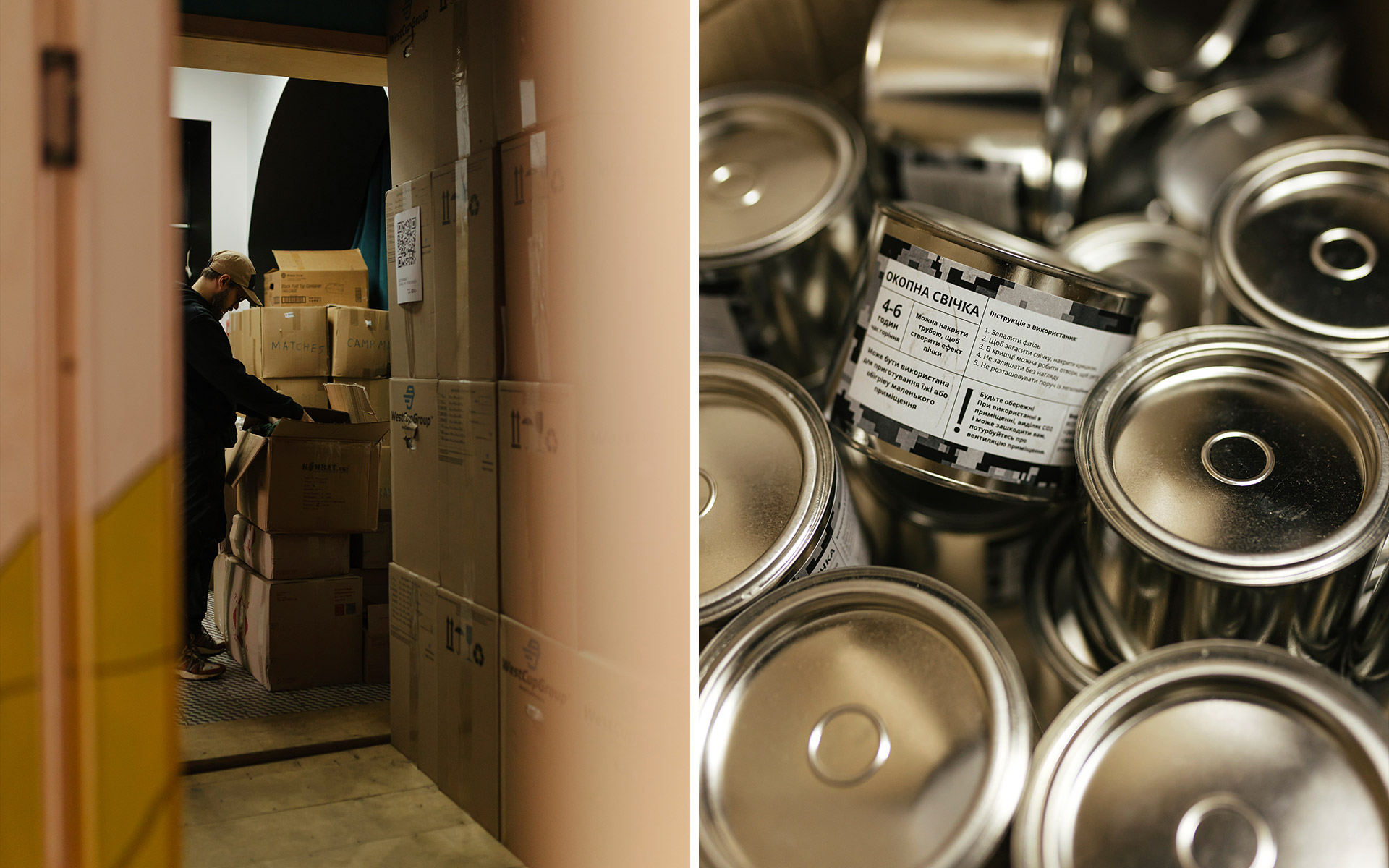
One of the first projects that the Foundation launched after reformatting is Make Them Warm. They started thinking about it back in August, because winter was approaching and it was important to start providing the military with thermal clothing and other warm clothes and equipment.
“First, we conducted a research on what exactly different soldiers need,” shares project manager Olya. “We made lists and started looking for where to buy these clothes items and whether we could contact manufacturers directly and sew them. Simultaneously, our PR team developed a communication strategy, as we needed to somehow collect donations. Not always people could understand why purchase warm clothes since soldiers seem to be provided with uniform. But there are always nuances: for example, females and males have completely different sizes, and if thermal underwear doesn’t fit, it doesn’t keep the military warm. The clothes they are given may be of the wrong size or the number of items may be insufficient.”
The major focus is quality rather than quantity, so the team had to become experts in completely new areas, i.e., in the field of warm clothing for the military.
“The Warm Campaign is something new for all of us. You order something to test it and see if it won’t wear out in five days due to poor quality. We only choose classy thermal underwear, fleeces, and tell in our social networks why that’s important — why thermal underwear should be two-layered and a fleece for UAH 500 [~USD 14] is a bad choice, why it’s so expensive after all. Often, people simply don’t see why one set can cost UAH 3,000 [~USD 82]. Though it may seem that we only have 7–8 requests from [military] units, for that we need UAH 1,300,000 [~USD 35,400].”
These requests are mostly group ones, so when the team modestly talks of one request, it can be about the needs of 30 to 70 soldiers.
In order to enhance the project’s performance through their restaurant background, the Hot Meal campaign was launched in friendly cafes. The latter choose a certain dish from the menu, and for a week or month, a percentage of its sales goes to the Warm Project.
“We started to operate nicely. Now we’re steadily collecting UAH 100,000 [~USD 2,723] per week via donations. This is, in fact, our first purely donation project. So one of the core messages is that we can get support from restaurants and businesses, as well as individuals. We’ve put up posters around the city telling that every donation is extremely important. We’ve also made up virtual items so that everyone could buy [as a donation] anything from a hand/foot warmer to a potbelly stove.”
The Foundation made sure that everyone helps to the best of their ability. For example, when a small bakery from Irpin got to know of the Warm Campaign, it started sewing. Thus, the Foundation received 30 buffs for the military — decorated with kids’ drawings.
Simultaneously, aiming to give Ukrainian children a holiday, the Kids for Kids project is gaining momentum within Kyiv Volunteer.
“In childhood, many of us have once got a box packed by a child from some European town. It contained various felt-tip pens, sweets, well, anything you could want.”
At least Leila, CEO of the Foundation, has had the experience, and it was she who initiated this project and is developing it within Kyiv Volunteer.
“The point of Kids for Kids is that children abroad can pack what they themselves would have liked to get for holidays. We then give these boxes to children from de-occupied territories, orphans, young hospital patients, and children who were forced to leave their homes. I call this ‘giving your universe to another child.’ We don’t even unpack these boxes so that the children could get them as they are, as children from abroad have packed them,” states the Foundation’s communicator.
One can just find, for example, a shoebox, fill it with everything the child wants, indicate the gender and age for which its contents is intended, and send it to the Foundation — and on December 20 or so, the parcels will be forwarded to the addressees.
“One woman has sent us a video of her niece packing a box. This little girl put inside the toy, which she had never even allowed anyone to hold. And now she said that a Ukrainian child needs this toy more. I melt from such stories in an instant. I start crying at first, and then I think how nice it is that we’ve launched such a global thing.”
The project’s Instagram contains numerous similar stories, sent though personal messages. Here is another one: a child from Germany asked their mother to translate a phrase to be able to sign a postcard in Ukrainian.
“This is so great a motif of a young person to make sure that a child in Ukraine will definitely understand them. This letter is full of mistakes, written in doodles, but is so sincere that you really start to believe in the best.”
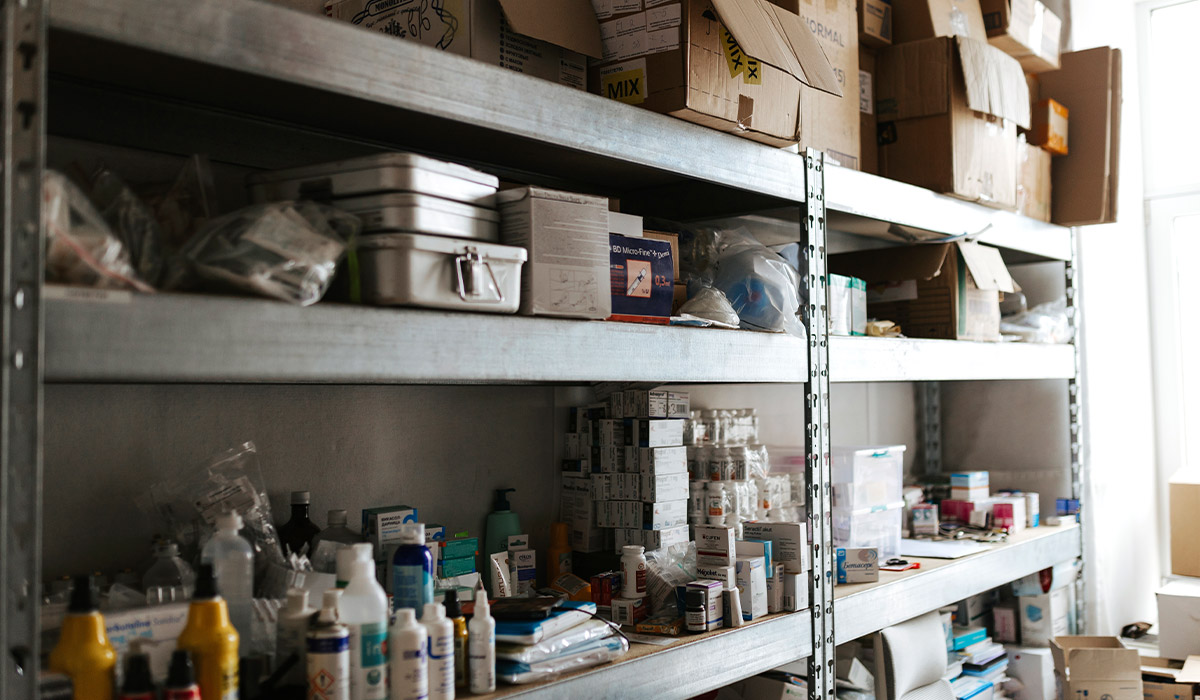
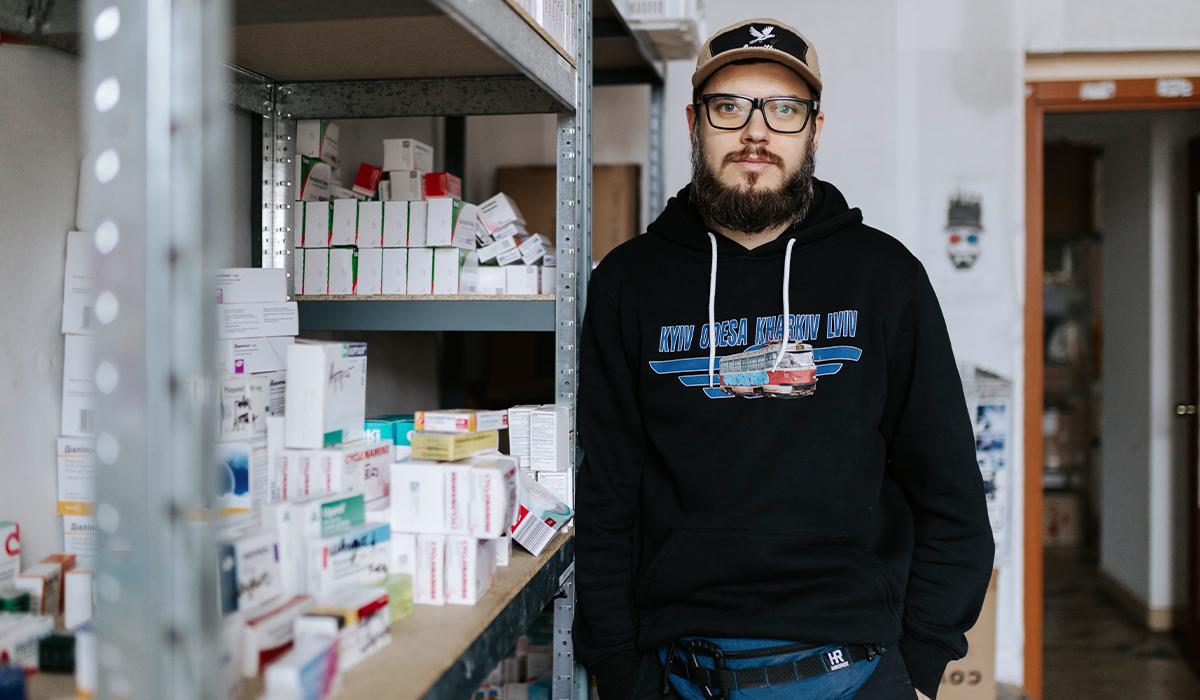
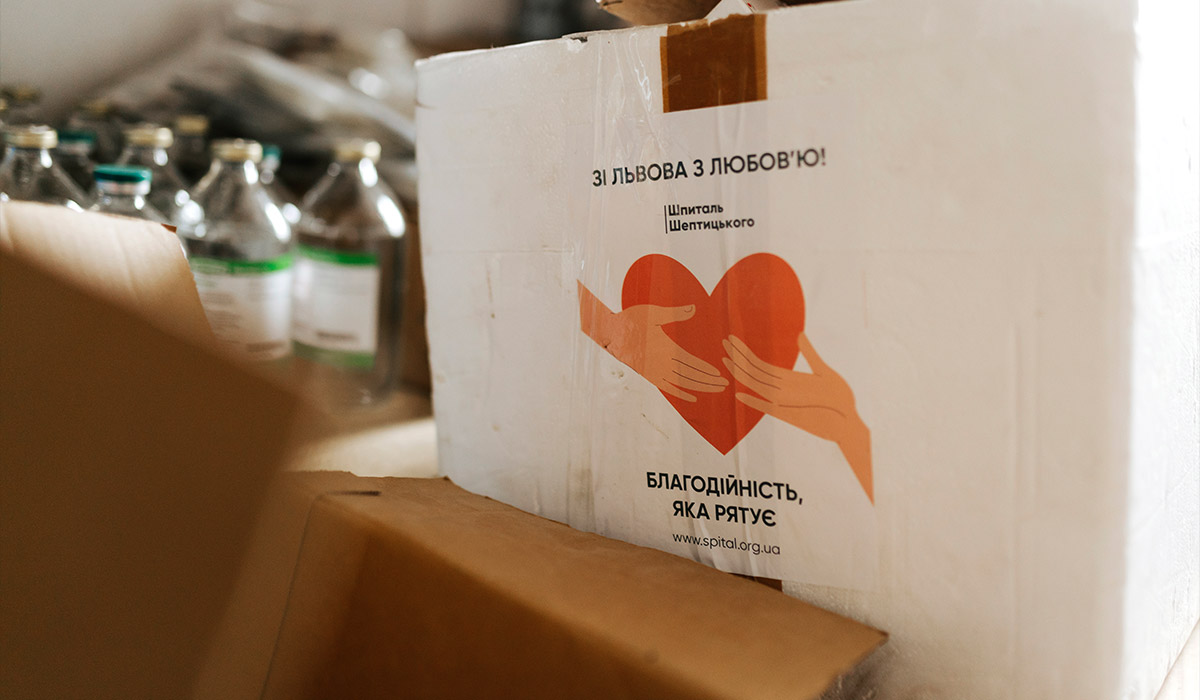
In addition to these two projects, the Foundation has from the start been involved in medicine. This is an extremely important area for the Foundation, identified already at the beginning of the full-scale invasion.
“Recently, there’s been a medical mission, with half of the staff travelling in Kharkiv direction. That’s how it all happens: we collect everything here, arrive by bus in a prearranged settlement, the bus door opens, and people approach it and take what they need. Someone needs insulin, someone heart medicines, and someone thyroid gland medicines. The demand is huge, people indeed lack many things. We now provide medical assistance upon request from civilians or military.”
Kyiv Volunteer and its office also host numerous one-off events: a book fair, charity markets, collaborations with institutions, and meetings for friendly projects. Recently, they have helped collect donations for the Punisher drone.
“In April, we started writing dictations in Dubler,” recalls Olya. “I brought Avramenko’s book; first, we just read it, and then we started dictating to ourselves and writing the texts down. Eventually, it turned into two or three charitable dictations. People could just come for a donation and write a dictation with us. And once a guy, who liked us very much, called at our place and just handed us a roll mat and a few warm blankets.”
“There are always some activities being held at our headquarters. If you need to hold an event, we are happy to provide the premises. We’re always ready to help — if help is needed, here we provide opportunities.”
Kyiv Volunteer has gone a busy, though not so long, way to become the Foundation it is now. And what it will be like in the future — time will show.
“If you go to Kyiv Volunteer page, you can see that the very first post is about a chatbot supposed to connect the request and the volunteer,” recalls Oleksandr Borovskyi, co-founder of the Foundation. “It was Slava Balbek’s idea, and when he developed it, he came up with a clear and simple name to make it easier to search for. Slava immediately involved his team and they created an identity — war is no excuse to ignore such things. But by the time the chatbot was developed, the very idea got irrelevant. From our own experience, we realized that the people who need help the most don’t know how to use it [the chatbot]. By then, we were already cooking thousands of portions, we had no an account, and had no time to create one and think about who we are. That’s why we simply wrung Slava’s Kyiv Volunteer account, and that’s it.”
Now, with one voice, the Foundation’s entire team claims they are ready for the marathon, because even after the victory, “we will still have to rebuild Ukraine for ten years or so.”
Helping the Foundation is easy — donate to current projects, attend events to have fun and benefit the society, and join initiatives by sharing information.
“For instance, we need to talk as much as possible about the Kids for Kids project, which connects children in Ukraine with children from abroad,” says the Foundation’s creative director. “So that all people having children and compassion could see and join.”
“You can also give an elderly woman your patronage and provide for her,” Oleksandr adds. “You can work with migrant children, repair schools, and clear debris in the north of Kyiv region. You just need to understand how much time you’ve got, find your small niche, and work on it, eventually finding enlightenment. And this will also help Kyiv Volunteer and the whole Ukraine.”
Please support Kyiv Volunteer here. You can also read this text in Ukrainian.